
Magnetic Push Slider vs. Mechanical Track Slider: Mechanism Physics, Liner Materials, and Buyer Guide

Magnetic push sliders and mechanical track sliders are the two core CNC pocket slider architectures, separating bold N52 magnetic pole snaps and unlimited freestyle freedom from captured spring-and-bead rails with dense, fine-grained clicks. Tested across our active shelf, guided mechanical tracks lead modern releases while free-floating magnets rule trick play.
Scan the newest CNC slider drops from independent EDC studios this year and one trend jumps off the bench immediately: mechanical track sliders have become the clear market mainstream. Nearly every new flagship push card arriving in our warehouse uses a guided internal track because players love effortless, closely spaced tactile rhythm that never sends a loose plate flying across the floor.
Yet magnetic push sliders hold onto a fiercely loyal following that mechanical rails can never replace - especially among free-floating freestyle players. In plain workbench language, magnetic feel is punchy and bold, whereas mechanical track feel is dense and fine-grained.

Punchy vs. Dense: Why Mechanical Tracks Lead Today and Where Magnets Still Rule
Newcomers browsing our fidget slider collection often assume magnetic and mechanical sliders simply make slightly different clicking sounds. In hand, their resistance curves behave like opposite instruments.
Magnetic sliders pull two plates together across invisible force fields, resisting your thumb firmly before snapping cleanly into the next pole pocket. Mechanical track sliders guide tiny detent balls over precision-milled notches via micro-springs, creating a dense, continuous cascade of crisp ticks suited to hours of relaxed play. Returning toys to that simple, uncomplicated joy in CNC hardware is why both architectures stay stocked on our bench.
Inside the Chassis: N52 Polarity Arrays vs. Spring-Loaded Detent Tracks
Inside a magnetic push slider sit matched rows of rare-earth neodymium magnets (typically Grade N52) epoxied or press-fit beneath thin internal plates. Sliding the top half shears opposing magnetic fields from peak attraction through brief repulsion into the next aligned column, generating sharp snap-back feedback with zero mechanical wear pins.
Inside a mechanical track slider, captive stainless steel, ceramic, or silicon-nitride balls sit atop miniature coil springs facing a CNC-grooved rail plate. Pushing the shell compresses each ball fractions of a millimeter across closely spaced teeth, keeping both halves mechanically locked together along a defined travel path. Compare how circular discs adapt these same two systems in our haptic coin vs. magnetic slider engineering guide.
12 In-Stock Magnetic and Mechanical Sliders Compared Side by Side
Every model in our 7-column comparison table below is verified active and in stock in our warehouse snapshot (6 magnetic builds followed by 6 mechanical track builds). Unstandardized studio decibel ratings are marked N/D alongside our hands-on feedback profile.
| Photo | Model & Stock | Architecture | Shell & Liner Material | Acoustic Profile | Bench Hand-Feel Verdict | Retail & Link |
|---|---|---|---|---|---|---|
 |
Mini SP SliderIn stock (4 colors) | Magnetic · 2-layer pocket push | CNC alloy + N52 array | Punchy Snap (N/D) | Bold magnetic steps in a compact card |
$36.30 View Piece |
 |
Honeycomb Infinite SliderIn stock (Steel) | Magnetic · Unlimited free-floating | 304 Stainless Steel | Freestyle (N/D) | 360-degree pivots; highest skill ceiling |
$51.99 View Piece |
 |
Zeus Triple-Layer SliderIn stock (G10 / Steel+Ti) | Magnetic · 3-layer push + pop coin | G10 or Steel + Titanium | Loud G10 / Bold (N/D) | Extended triple-step stroke for medium-large hands |
$67.34 - $107.38 View Piece |
 |
Snap Side-Push SliderIn stock (3 finishes) | Magnetic · Lateral finger-snap pivot | CNC stainless alloy | Crisp Chime (N/D) | Sideways thumb snap with audible ring |
$91.62 View Piece |
 |
Hertz Tuning Fork SliderIn stock (Titanium) | Magnetic · Resonant tuning-fork body | CNC Titanium | Harmonic Ring (N/D) | Featherlight Ti frame with clear fork note |
$91.75 View Piece |
 |
Pulse SliderIn stock (4 colors) | Magnetic · Guided strong-detent card | Anodized & machined alloy | Strong Detent (N/D) | Firm magnetic lockup without plate fly-off |
$92.30 View Piece |
 |
Aurora Double-TrackIn stock (9 colors) | Mechanical · Dual bead-spring tracks | CNC alloy chassis | Crisp Double-Tick (N/D) | Accessible entry into guided mechanical clicks |
$36.30 View Piece |
 |
Groove Slider Youth EditionIn stock (Steel / Zr) | Mechanical · Linear track + PTFE block | Stainless Steel or Zirconium | Damped Glide (N/D) | Founder daily staple; silky Teflon-cushioned push |
$49.99 - $220.99 View Piece |
 |
Yinmaru Sound SliderIn stock (PEEK / PEI) | Mechanical · Four-track dense clicker | Machined PEEK or PEI | Bright & Loud (N/D) | Ultra-light polymer body with loud, crisp cadence |
$50.76 View Piece |
 |
Sinian Fidget SliderIn stock (Alu / PEI+Steel) | Mechanical · Track + rotor + ratchet | Red Aluminum or PEI + Steel | Multi-Action (N/D) | Calm rotor thumbing or loud freestyle swings |
$99.00 - $140.65 View Piece |
 |
Sea Shark SliderIn stock (PEI / Steel) | Mechanical · Linear track + rotor play | PEI or 304 Stainless Steel | Dense & Crisp (N/D) | Founder pick; effortless track push + bonus rotor |
$99.72 - $152.77 View Piece |
 |
Viper SliderIn stock (Titanium) | Mechanical · Extra-long dense track | Grade 5 Titanium | Fine-Tooth Tick (N/D) | Extended multi-notch stroke for marathon sessions |
$112.44 View Piece |
Magnetic Push Sliders: Bold Snap and the High Skill Ceiling of Free-Floating Play
Magnetic sliders split into two sub-families: track-limited magnetic cards (which keep both halves tethered via internal guide slots) and unlimited free-floating magnetic sliders (held together solely by magnetic pull). Compact limited or semi-guided magnetic models like Mini SP ($36.30), Pulse Slider ($92.30), side-snapping Snap ($91.62), and the titanium Hertz Tuning Fork Slider ($91.75) deliver bold magnetic punch without launching plates across your desk.

Unlimited free-floating builds like the Honeycomb Infinite Slider ($51.99) unlock 360-degree corner pivots, windmills, and ladder tricks no mechanical rail can ever imitate. However, newcomers need a candid warning: free-floating magnetic sliders have the highest learning curve of any slider. Starting directly on an unlimited slider causes frequent plate drops and convinces beginners that all EDC hardware is fussy - so master a limited slider first, then graduate to free-floating play.
Mechanical Track Sliders: Dense Cadence, PTFE Blocks, and Bonus Rotor Play
Mechanical track sliders dominate daily carry because you can pull one from a pocket half-asleep and enjoy crisp, zero-drop clicks immediately. Entry-friendly Aurora Double-Track Slider ($36.30) introduces dual-rail "ding-ding" rhythm at an approachable price, while Grade 5 titanium Viper Slider ($112.44) stretches the rail for extra-long multi-notch strokes.
Two mechanical builds earn special praise at our own workbench: the Sea Shark Slider ($99.72 in PEI, $152.77 in 304 Stainless Steel) and our daily desk staple, the Groove Slider Youth Edition ($49.99 in Stainless Steel up to $220.99 in Zirconium Oil Slick). Much like the Groove Youth Edition, Sea Shark pairs an ultra-satisfying linear track with an engaging secondary rotor play mode, while Sinian ($99.00 - $140.65) adds multi-action ratchet and freestyle versatility.
Liner vs. Shell Materials: Loud PEI/PEEK/G10 Cores and Crowd-Favorite Zirconium
Players often ask whether acoustic volume comes from the outer shell or the internal track insert, and whether tuning-fork chimes beat mechanical clicks (see our tuning fork slider guide and quiet office fidgets guide). While sound taste is personal, dense mechanical track clicks hold up best for long-term daily play across far more settings without ear fatigue.

Material physics splits cleanly between inner liners and outer shells. Whenever the internal liner or contact body is machined from high-stiffness polymers or composites like PEEK, PEI, or G10 - as found on Yinmaru Sound Slider ($50.76), Sea Shark PEI ($99.72), and Zeus G10 ($67.34) - the acoustic snap rings out bright and loud. On the outer shell side, heat-blackened zirconium (such as Groove Slider Youth Edition Zirconium at $220.99) remains the undisputed enthusiast favorite for warm, velvety grip.
Two-Layer vs. Three-Layer Thickness: Effortless Pushing Beats Layer Hype
Three-layer sliders like Zeus ($67.34 in G10, $107.38 in Stainless Steel + Titanium) add an extra telescoping step plus a central pop-coin ring, delivering extended travel in larger palms. However, we advise players with smaller hands to skip thick three-layer stacks because extra stack height forces wider thumb extension.

At the end of the day, the essence of any slider is simply pushing back and forth. Effortless pushing paired with rewarding feedback means you can push it for hours, and pushing it for hours means lasting joy - so prioritize low-effort ergonomics over raw layer count.
PTFE Tape Glide Mods and the Smartphone-Stand Teardown Rule
Two practical workbench habits will save your sliders from scratches and lost springs. First, adhesive polytetrafluoroethylene (PTFE) tape upgrades both camps: placing a thin PTFE strip between magnetic plates prevents rub tracks while making magnet-over-magnet travel slicker, and mechanical track players apply PTFE tape along internal guide faces for an even silkier stroke and surface protection.
Second, before you ever unscrew a mechanical track slider to swap springs or beads, look up a teardown video or mount your smartphone on a desk stand and record your own disassembly from start to finish. If tiny springs pop loose or asymmetric track plates confuse you afterward, replaying your own video makes reassembly effortless.
First-Slider Decision Matrix: Matching Mechanism to Hand Size and Skill
Use our six-scenario bench table below to match your experience level, hand size, and sound preference to an active in-stock slider.
| Buyer Profile / Goal | Target Architecture | In-Stock EDCG Pick | Workbench Verdict |
|---|---|---|---|
| Complete beginner buying a very first CNC slider | Guided Mechanical Track Slider | Aurora Double-Track Slider | Zero risk of launching a loose top plate onto the floor, with immediate dense mechanical cadence. |
| All-day effortless track play plus bonus rotor action | Mechanical Track + Secondary Rotor | Sea Shark Slider | Our bench highlight alongside Groove Youth Edition - combines tireless linear clicks with a built-in rotor. |
| Enthusiast upgrading to a Zirconium shell or quiet PTFE track | PTFE-Block Mechanical Track | Groove Slider Youth Edition | Available from accessible stainless steel up to crowd-favorite Zirconium Oil Slick with a black PTFE block. |
| Experienced player chasing 360-degree freestyle tricks | Unlimited Free-Floating Magnetic Slider | Honeycomb Infinite Slider | Unrestricted N52 plate freedom enables ladder flips and pivots no fixed mechanical rail can replicate. |
| Fan of bright, loud polymer liner acoustics | Four-Track PEEK / PEI Mechanical Slider | Yinmaru Sound Slider | PEEK and PEI internal surfaces amplify detent impacts into a remarkably bright, lively snap. |
| Undecided starter on a $25 to $40 budget | Single-Purchase Surprise EDC Selection | Mystery Fidget Box (One-Time) | Leave the choice to fate with a brand-new bench-packed piece and zero recurring subscription. |
Featured In-Stock Magnetic and Mechanical Sliders
All six magnetic and mechanical benchmarks below are verified active in stock for immediate single-item purchase with zero subscription required.
Sea Shark Slider
Dense mechanical track indexing paired with a built-in rotor mode in loud PEI or solid stainless steel.
Check Spec & Stock
Groove Slider Youth Edition
Smooth black PTFE Teflon block track available from everyday stainless steel up to Zirconium Oil Slick.
Check Spec & Stock
Yinmaru Sound Slider
Featherlight PEEK and PEI polymer construction engineered for bright, resonant four-track mechanical rhythm.
Check Spec & Stock
Viper Slider
Extended multi-click titanium rail crafted for effortless, fine-grained back-and-forth sessions.
Check Spec & Stock
Honeycomb Infinite Slider
Unrestricted stainless steel magnetic plates built for seasoned freestyle pivots, ladders, and rotations.
Check Spec & Stock
Zeus Triple-Layer Slider
Punchy three-tier magnetic travel combined with a central rotary pop coin for medium-to-large palms.
Check Spec & StockSub-$40 Starters, One-Time Boxes, and Free Worldwide Shipping ($60+)
Every order reaching $60.00 USD or more unlocks automatic Free Worldwide Tracked Shipping at EDC GATEWAY (waiving the $5.20 USD standard shipping fee). Pair punchy magnetic and dense mechanical play or explore our one-time mystery box collection:
- Leave It to Fate Starter ($26.88 Solo, or $63.18 Free-Shipping Pair): Undecided between magnetic and mechanical on a $25-$40 budget? Grab 1 Mystery Fidget Box (One-Time) ($26.88, zero subscription), or pair it with Aurora Double-Track ($36.30) to ship free at $63.18.
- Punchy vs. Dense Head-to-Head Kit ($72.60, Ships Free): Combine Mini SP ($36.30) with Aurora Double-Track ($36.30) to feel both N52 magnetic snap and dual-rail mechanical cadence side by side.
Frequently Asked Questions
Should a beginner buy a magnetic push slider or a mechanical track slider first?
Go straight for a mechanical track slider as your very first CNC piece. Almost every new studio release on the market today uses a guided mechanical track because captured rails prevent accidental plate drops and deliver dense, effortless clicks right out of the box with zero learning frustration.
How does the hand-feel of a magnetic slider differ from a mechanical track slider?
Our workbench sums up the contrast in two words: magnetic sliders feel punchy, whereas mechanical track sliders feel dense. Opposing N52 magnets snap decisively from pole to pole with bold force, while spring-loaded detent balls rolling over micro-grooves create a fine-grained, closely spaced zipper-like rhythm.
Are unlimited free-floating magnetic sliders hard for beginners to control?
Yes. Unlimited free-floating magnetic sliders like the Honeycomb Infinite Slider ($51.99) actually carry the highest entry barrier in the slider category. Without physical stop pins, unpracticed thumbs easily push the top plate off onto the floor, so always learn on a track-limited slider before tackling free-floating tricks.
Why do experienced players still keep free-floating magnetic sliders if mechanical tracks dominate?
Because fixed mechanical rails lock motion into predetermined straight or pivoting paths. Free-floating magnetic sliders empower a dedicated freestyle community to perform 360-degree corner pivots, ladder flips, and rotational flourishes across open N52 magnet matrices - a creative freedom guided tracks can never replace.
How can I disassemble a mechanical track slider without losing internal springs or beads?
Before touching a precision driver, look up a teardown video for your model or clamp your smartphone onto a desk stand and record yourself unscrewing the plates step by step. If tiny springs shift or internal track orientation confuses you afterward, simply replay your own footage to restore everything cleanly.
Does PTFE Teflon tape work on both magnetic sliders and mechanical track sliders?
Yes. Laying a thin strip of adhesive PTFE tape between magnetic plates prevents rub scratches and makes pole-to-pole travel noticeably slicker. Many mechanical track owners also apply PTFE tape along internal mating guides to boost sliding silkiness while shielding precision surfaces from friction wear.
Which inner liner and outer shell materials sound loudest or feel best on EDC sliders?
Whenever a slider uses PEI, PEEK, or G10 for its internal liner or contact body - such as Yinmaru Sound Slider ($50.76), Zeus G10 ($67.34), or Sea Shark PEI ($99.72) - acoustic clicks project brightly and loudly. For outer shells, machined zirconium remains the runaway enthusiast favorite.
Is a three-layer slider better than a standard two-layer slider?
Neither layer count is inherently superior, though players with smaller hands should avoid thick three-layer builds like Zeus ($67.34 - $107.38) in favor of slimmer two-layer profiles. A great slider simply pushes effortlessly back and forth so your thumb enjoys hours of fatigue-free motion.
What should I pick on a $25 to $40 starter budget, and when is shipping free?
You can grab an exact guided starter like Aurora Double-Track ($36.30) or Mini SP ($36.30), or leave the decision to fate with our Mystery Fidget Box (One-Time) at $26.88 (zero subscription). Any cart totaling $60.00 USD or more unlocks automatic Free Worldwide Tracked Shipping.
Last updated by the EDC GATEWAY Workshop Engineering Team.
Shop Magnetic & Track Fidget Sliders



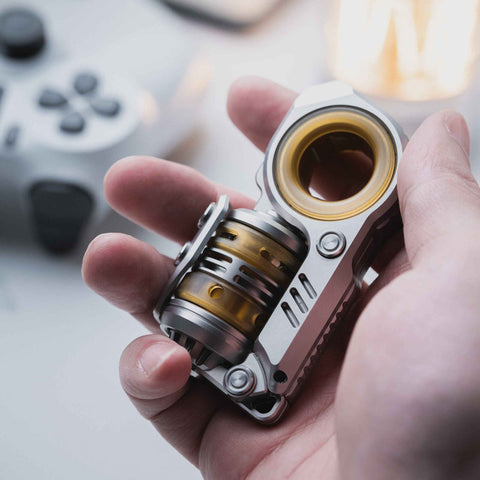
Zoom Slider — Stainless Steel Mechanical Ring Fidget Slider (Recreation Edition)
More CNC Mechanism & Buying Guides
Starter CNC Metal EDC Fidgets Buyer Guide: Exact-Pick Singles vs. One-Time Mystery Boxes Compared
Going from 0 to 1 in precision CNC everyday carry: compare hand-picked starter sliders and spinners against non-duplicate one-time mystery boxes, unboxing...
Read Guide → Nov 14, 2026Metal Fidget Spinner Engineering Guide: R188 Bearings, Armor-Opening Linkages, and CNC Alloys Compared
Move past plastic novelties and spin-time myths: our bench breaks down R188 bearing swaps, addictive armor-opening linkage spinners, two-arm wobble richness, and...
Read Guide → Nov 14, 2026Best Alternatives to Stress Balls for Quiet Office Focus: Pocket-Slim CNC EDC Fidgets Ranked by Stealth
Ditch tacky, pocket-bulging silicone stress balls for precision CNC metal spinners, wearable ratchet rings, corded beads, and damped sliders vetted at our...
Read Guide →


